On Being A Subversive

The most subversive thing we could do is to reserve judgment about one another. The most countercultural society would be one in which everyone, everywhere, just kept an open mind.
I sometimes think about how a society like this might function. People would approach each other in warm and friendly ways, not really seeing how a person looks or dresses, but simply seeing someone else as another individual worthy of respect. A conversation might start. Person 1 might talk with Person 2 and discover many common interests: a devotion to family, a love of children, a joy in good food and easy talk with friends, a desire to find work that one enjoys and gives meaning to one’s existence, a mutual love of coffee or books.
During the course of the conversation, differences would be seen and noted. Backgrounds would give distinction to each person. One might be of a particular religious background, a specific political persuasion or socio-economic level; the other might be colored and shaped by an entirely different set of beliefs and experiences. Yet the soul of the other person is mirrored in the eyes of the first. Each sees in the other, despite these differences, a fellow traveler on the confusing road of life, someone who has somehow developed the same common love of family, food, friends, meaningful work, pleasures and pursuits. The differences do not cleave a chasm between these individuals because the similarities are serving as a bridge between vastly different worlds. The individuals wonder: How did this person come to the same set of standards as me and yet be so different? Can so many different roads lead to the same place? Are we each journeying toward the same universal truth?
Our culture is one that highlights and stokes divisions and differences among races, religions, generations, countries, states, neighborhoods, families, friends. It seeks to hide, disregard, minimize and discount all of our common strengths, hopes and failings. We point fingers and judge without complete proof or evidence and we prop up and celebrate anyone who agrees with our preconceived notions and worldviews. We never judge the whole of a man or a woman, only the parts we see as most like us and then damn the parts least like us. We believe pencil sketches are people. We too frequently see only a god or devil, not a mirror of our own clay. George Washington is only a hero or a slaveowner. Grandpa is a sweet old man or a moron because he voted for that political party. The drug addict is a victim or a monster. The list goes on.
Not long after the Cuban Missile Crisis, President John F. Kennedy gave the commencement address at American University in Washington, D.C., in which he sought to ease Cold War tensions with the Soviet Union. He understood, perhaps more than any American president of the nuclear age, just how close we had come during the fall of 1962 to complete annihilation because of our political differences with the Soviets. The communist system of government is monstrously oppressive and anathema to American life and liberty. But Kennedy had begun to understand that the obliteration of the human race over politics was madness. And he had also begun to understand that we and the Soviets had more in common than we might think. During the speech, he noted: “[L]et us not be blind to our differences—but let us also direct attention to our common interests and to the means by which those differences can be resolved. And if we cannot end now our differences, at least we can help make the world safe for diversity. For, in the final analysis, our most basic common link is that we all inhabit this small planet. We all breathe the same air. We all cherish our children’s future. And we are all mortal.”
We are told frequently by an unrepentantly hyperbolic press than we live in divided political times that are unprecedented in American life. The unprecedented part is completely false. Let’s not forget we had a civil war. Surely divisions were worse in an era in which an entire section of the country attempted to secede from the rest of the nation and killed more than 620,000 fellow citizens in the process. The first part about living in divided political times is also misleading. Our elections have been heated and ugly from the start. Students of history will remember the vicious and slanderous election of 1800, which pitted the now-marble statues of Thomas Jefferson against John Adams in a battle in which they threw ugly accusations against one another in the press. What is different now is that our media—and especially social media—has far greater power to focus their lenses almost exclusively on our differences. They turn people into two-dimensional cartoons with even greater skill for ratings, clicks and profits.
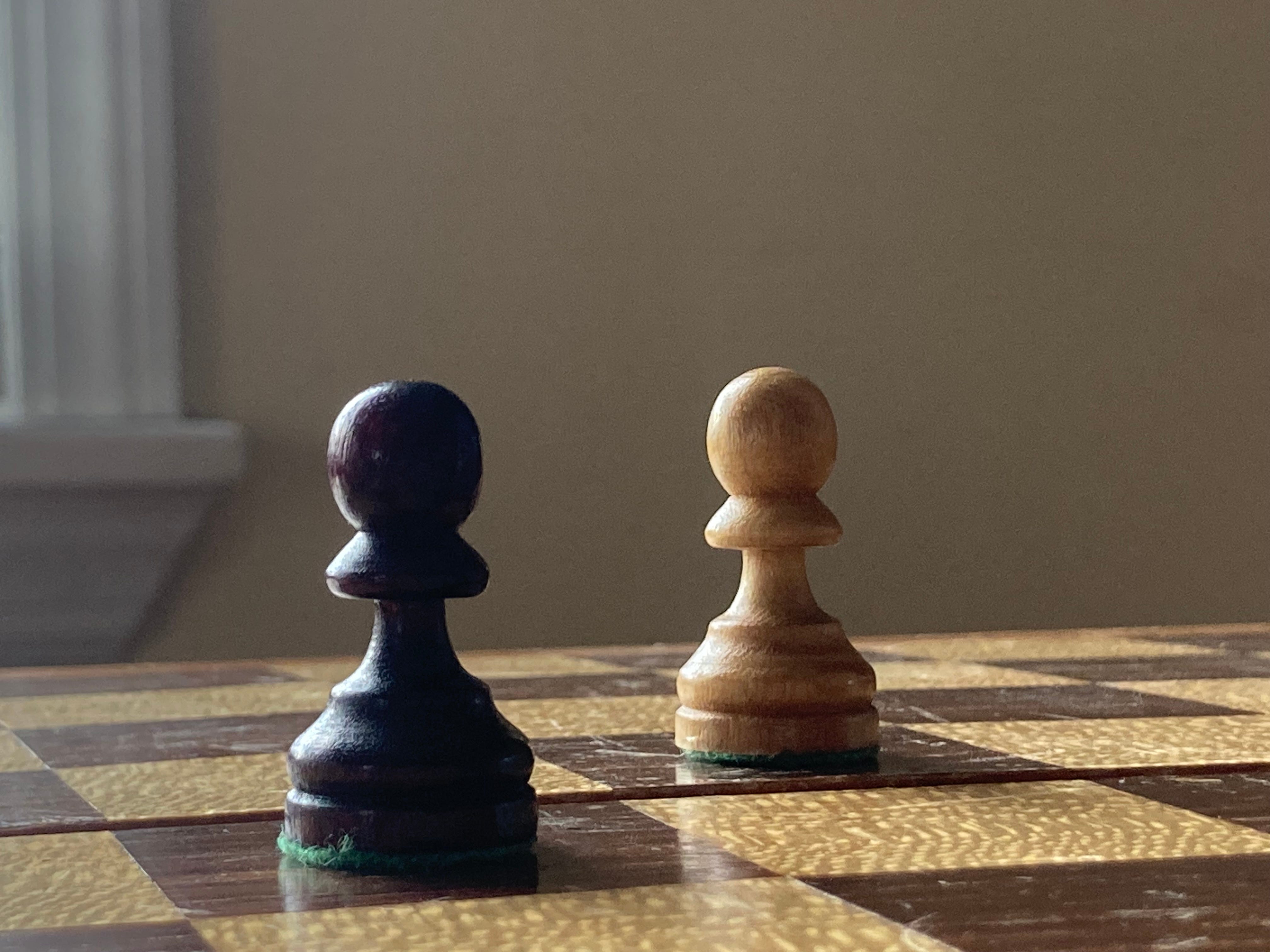
We are pawns in a game, not seeing our same forms and functions, but only the difference in our colors.
Subversion means to literally turn something over. Often the word is connected in our minds with the overthrow of a government. But what I’m suggesting here is not anything like that. What I mean is to turn over the preconceived notions in our minds about everyone, but especially all of the people who are supposedly different from us, who are the cartoon villains that need to be shunned, isolated, canceled, blocked. To subvert here is to overturn the modern societal ideas about estranging ourselves from anyone with whom we might disagree or who might have beliefs or a past that we feel like we can pass judgment on.
Remove the judgment, open the mind, seek the commonalties of the human condition, give forgiveness and compassion, bury the anger and the hate, and we come to understand a most basic truth about the human condition: that we may be wrong. By understanding that simple idea, we forge a countercultural society in which we see every human being as a brother or sister who is just as frail and as wonderful and as messed up as we are.